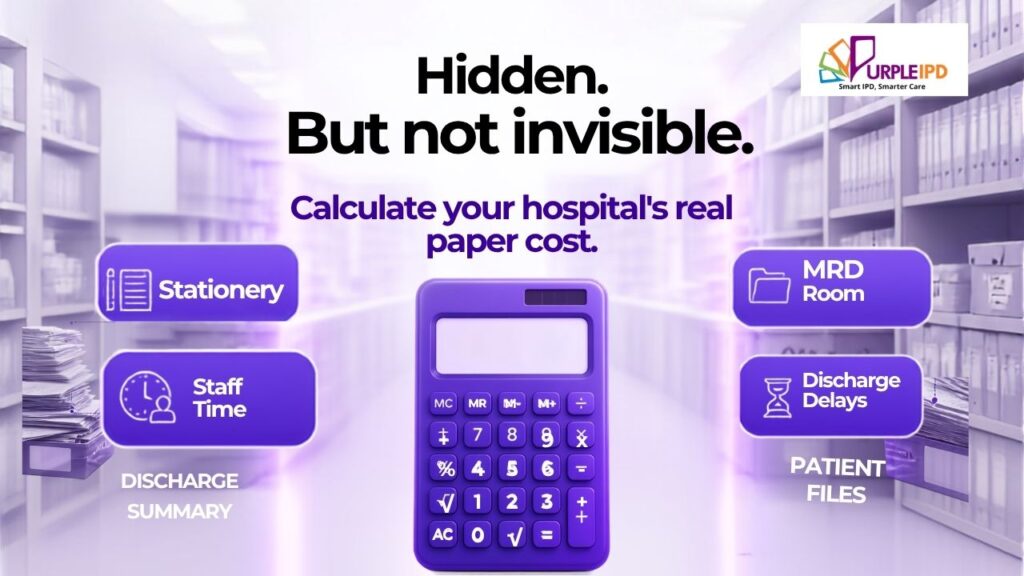
Do You Know How Much Is Your Hospital Spending on Stationery?
Free Calculator · Hospital Operations
Most hospital owners underestimate this number by 60%. Enter 4 numbers below and find out yours – in 30 seconds.
Calculate your hidden cost of statioery
Every hospital administrator is looking for ways to increase profitability: new revenue streams, better occupancy, faster collections. But there is a category of expense — the hospital stationery cost in India — that quietly drains lakhs every year while nobody is watching. Not because it is hidden. Because it is so distributed across departments that nobody ever adds it up.
The insight most hospital owners miss: A 100-bed NABH hospital doing 6,000 admissions a year spends approximately ₹6 lakhs annually on direct paper costs alone — stationery, printing, scanning, and shredding. Add indirect costs — staff time on file handling, TPA coordination, discharge preparation, clinical record retrieval — and the number crosses ₹15 lakhs per year. Over 5 years, that is ₹75 lakhs spent maintaining a paper system that is slowing your hospital down.
What hospital stationery and paper is actually costing you
Here are the expense heads that most hospital administrators never see on a single report — because they are spread across stationery budgets, HR costs, facility costs, and operational overhead.
→
Stationery and printing
A NABH-accredited hospital generates 100–150 pages per patient admission — nursing charts, vitals records, medication administration records, consent forms, investigation slips, progress notes, discharge summary, labels. At ₹0.85–1 per page, a 100-bed hospital doing 6,000 admissions spends ₹5–7 lakhs a year on paper and printing alone. Nobody budgets for this explicitly. It just gets paid, every month, through consumables.
→
The MRD room — space that earns nothing
Regulations require hospitals to retain patient records for 5–7 years. A 100-bed hospital accumulates 30,000–40,000 files over this period. That needs 300–500 sqft of dedicated storage — an MRD room, an MRD head, pest control contracts, filing supplies, and retrieval staff. That space could be a consultation room or private ward generating ₹2–5 lakhs a year in clinical revenue. Instead, it stores paper.
→
EMRD preparation — 30–40 minutes per discharge
Before every discharge, the head nurse sequences the file, checks for missing pages, verifies labels, manually creates the EMRD checklist by turning every page, and rechecks the count. For a hospital doing 6,000 admissions a year — that is 3,000–4,000 hours of senior nursing time spent on paperwork, not patient care.
→
TPA and insurance documentation — 30 minutes per insurance patient
Every TPA, CGHS, RGHS, or AB-PMJAY claim requires retrieving the file, scanning specific pages, photocopying documentation, handling queries, and correcting discrepancies. For a hospital where 35% of patients are insured — that is 1,050 hours of staff time on claim documentation every year.
→
Discharge delay — the most expensive hidden cost
A hospital recovering 4 hours of discharge time across its patient volume can admit 200 additional patients per year — at ₹40,000 average billing, that is ₹80 lakhs of additional annual revenue. Not a cost saving. Additional revenue from a bed that was already yours.
→
File retrieval — time nobody tracks
The file is with the nutritionist. The anaesthesiologist took it. It’s in the consultant’s cabin. Staff spend 30 minutes per patient managing file movement between departments. Over 5 years, ₹13.5 lakhs of staff time spent walking files between rooms.
This is not an expense. It is a trapped investment. Your hospital is already spending ₹15–25 lakhs every year on paper. Going paperless does not add a new cost line — it redirects money you are already spending into a system that makes your hospital faster, more compliant, and more profitable. The question is not whether you can afford to go paperless. It is whether you can afford to keep paying for paper.
Why most hospitals underestimate their hospital stationery cost by 60%
The reason is simple: nobody has ever added it up in one place. The stationery bill goes to admin. The MRD room cost is in facilities. The staff time is in HR. The scanning cost is in operations. No single report combines all of these, so no single person is accountable for the total.
And then there is the file size problem. Ask any hospital administrator how many pages are in their average patient file. They say 40–50. Count the actual file — nursing charts for each shift, vitals records, medication administration records, consent forms, investigation request slips, lab and radiology reports, progress notes, specialist referral notes, old records carried forward, discharge summary, labels — and the real number for a NABH-accredited hospital is 100–150 pages. That 60–70% difference compounds across thousands of admissions every year.
The real insight: Going paperless is not a technology expense. It is a redirection of money you are already spending — on paper, storage, staff time, and insurance documentation — into a system that makes your hospital faster, more compliant, and more profitable. A 100-bed hospital that recovers 4 hours of discharge time per patient can admit 200 additional patients per year. At ₹40,000 average billing, that is ₹80 lakhs of additional annual revenue from beds you already own and staff you already pay.
PurpleIPD is tablet-based bedside IPD software built specifically for Indian hospitals. It eliminates hospital stationery costs by replacing paper forms with digital documentation at the bedside — on tablets that match your existing paper charts exactly. The data stays on your server. On-premise, DPDP compliant, no cloud dependency. Nurses adapt in 1–2 days with no training needed.